Can AI Scrape Any Website? A Test of 13 Popular Sites
By Ashesh DhakalUpdated 5 min read
The short version: I pointed one AI web scraper at 13 popular websites, with no custom setup on any of them, and 10 returned clean, structured data. The 3 that failed — Amazon, Zillow, and AliExpress — didn't return partial or messy results; they returned nothing, blocked before a single row rendered. That split is the whole story of what AI scraping can and can't do in 2026, so here's the full run with the numbers behind it.
I run Website Scraper, so treat me as biased and weigh the method accordingly — which is exactly why I'm showing every result, including the failures, rather than a curated highlight reel. Every number below is from a real run I did on 2026-07-06.
The method
I gave each site the same treatment: paste the URL, use the default "find the main data on this page" extraction with no columns specified and no per-site tuning, and record what came back. One run per site. The point wasn't to squeeze out a best-case result with hand-tuned prompts — it was to see what a person gets on the first, lazy try. I picked 13 sites to span the range: two scraping sandboxes, news and aggregator pages, a reference table, a jobs board, mid-tier retail, and the biggest, most defended consumer sites on the web.
The results
| Website | Result | Rows | Time |
|---|---|---|---|
| Hacker News | ✅ Scraped | 30 | 50s |
| Product Hunt | ✅ Scraped | 23 | 28s |
| GitHub Trending | ✅ Scraped | 22 | 51s |
| books.toscrape.com | ✅ Scraped | 20 | 20s |
| Wikipedia (largest companies) | ✅ Scraped | 20 | 42s |
| quotes.toscrape.com | ✅ Scraped | 10 | 23s |
| We Work Remotely | ✅ Scraped | 10 | 50s |
| Best Buy (search) | ✅ Scraped | 10 | 24s |
| eBay (search) | ✅ Scraped | 10 | 32s |
| Realtor.com (listings) | ✅ Scraped | 10 | 13s |
| Amazon (search) | ❌ Blocked | 0 | 8s |
| Zillow (listings) | ❌ Blocked | 0 | 6s |
| AliExpress (search) | ❌ Blocked | 0 | 8s |
10 of 13 scraped cleanly; 3 were blocked. No site returned a half-broken table — it was clean data or nothing, which itself is worth knowing: AI extraction rarely gives you garbage, it gives you rows or a wall.
Finding 1: the failures are the sites with dedicated anti-bot teams
The three that blocked — Amazon, Zillow, AliExpress — aren't random. They're among the most scraped sites on the internet, which means they're also among the most defended: each runs bot-detection built specifically to stop automated access. Everything that succeeded was either a content-forward site (news, reference, jobs, code) or a mid-tier catalog (eBay, Best Buy, Realtor.com) without that level of investment. The dividing line isn't "big vs. small" — it's "does this company pay a team to keep scrapers out."
Finding 2: a block fails fast, and that speed is a tell
Here's the most useful number in the whole test. The 10 sites that scraped took 33 seconds on average — the time to fetch, render, and extract a real page. The 3 that blocked averaged 7.4 seconds, a near-instant zero. That gap is diagnostic: a genuine extraction takes time because the page actually loads; a block is quick because the site rejects the request before serving anything. If a scrape comes back empty in a few seconds, you're almost certainly looking at a block, not a bug you can prompt your way around. Spending an hour tweaking selectors for Amazon is time you now know not to spend.
Finding 3: the AI got the data right but sometimes labeled it wrong
On the sites that worked, the values were accurate — but with no columns specified, the labels occasionally weren't. On Hacker News it correctly pulled each story's title, description, and category, but filed everything under a product_id/product_name/price shape, because the default prompt leans toward a shopping schema. On the Wikipedia companies table it captured Amazon's $716B revenue correctly, then labeled the column product_price. The data was never wrong; the schema was sometimes off — and that's a one-line fix: name the columns you want ("title, points, comments") and the AI returns exactly those, correctly labeled. It's the difference between letting the AI guess the shape and telling it. For anything you'll rely on, tell it.
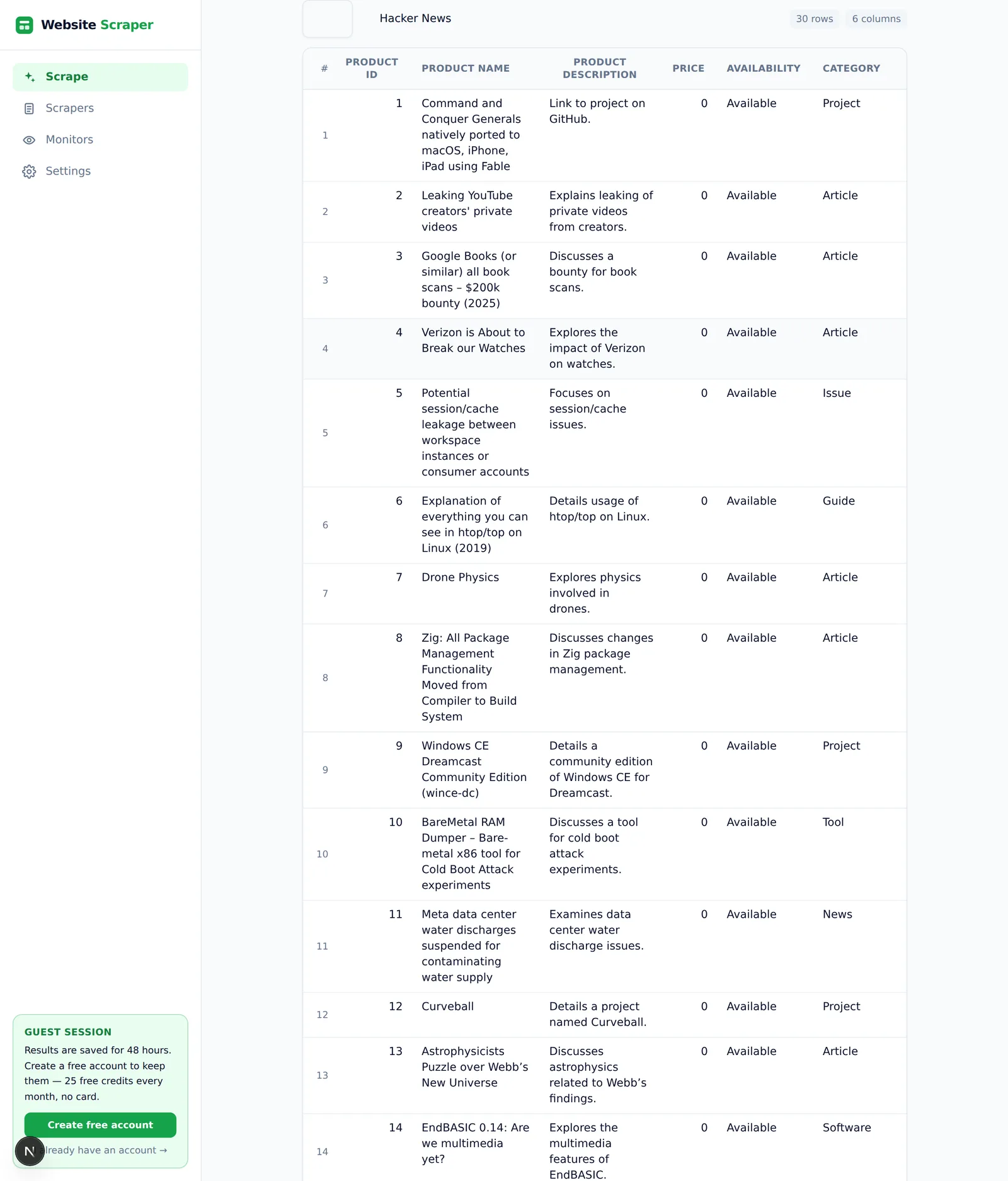
The blocked sites, for contrast, never got this far — no table, no columns, just a fast empty result.
What this means if you're choosing a tool
Three practical takeaways, earned from the run above:
- Most of the public web is scrapeable with AI extraction, no code required. News, reference, listings, jobs, and the majority of catalogs came back clean on the first try. If your target is one of those, you're in easy territory.
- The heavily-defended giants are a different problem. Amazon, Zillow, and their peers block on purpose, and no honest tool clears them reliably. Anyone promising "scrape any site, guaranteed" is selling you the 77%, not the 100%.
- Test your specific target before you commit. The only reliable way to know which bucket a site is in is to run it once. On Website Scraper a failed scrape is never charged, so testing a target costs you nothing — paste the URL and you'll know in under a minute, faster if it's blocked.
The honest caveats
This is one data point, not gospel. It's a single tool, one run per site, the default prompt, and a snapshot on one day — anti-bot systems and page layouts change, and a site that blocked today might not next month (or vice versa). A hand-tuned run, a different tool, or a residential-proxy setup would move some results. What holds regardless of those variables is the shape of the map: the open, content-serving majority of the web is well within reach of AI scraping, and a specific, identifiable set of fortress sites is not. If you want to see it for yourself, the AI website scraper on the homepage runs your first scrape free, and the guides on how to scrape data from a website and whether web scraping is legal cover the how and the rules. For the sites that did pass, there are tuned walkthroughs for the eBay scraper, the Best Buy scraper, and the real estate scraper.